
The Trap Field
Posted On: 08-14-2024
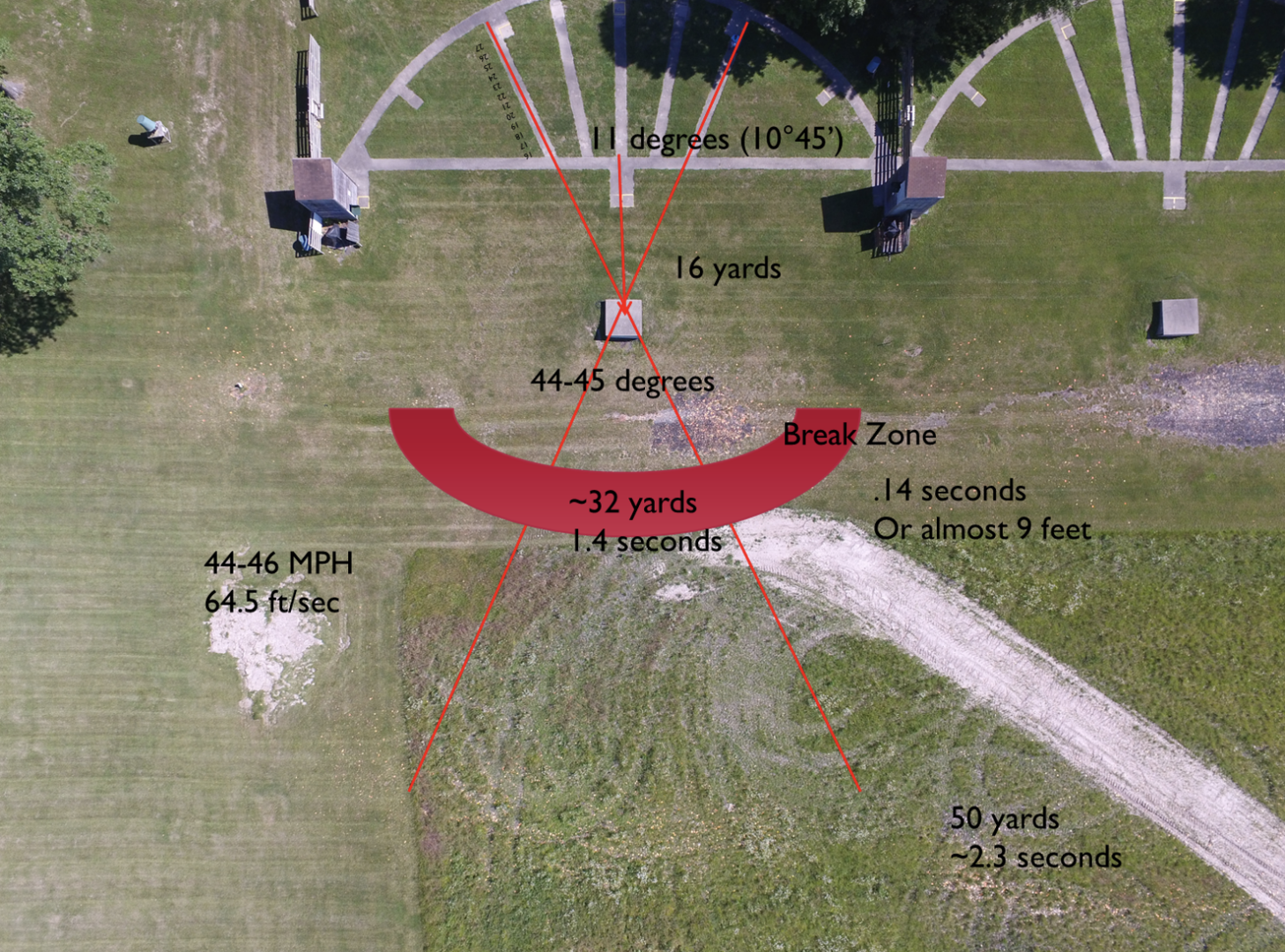
The trap field is a geometric shape and is designed to be replicated at all venues. I thought it would be good for folks to see the measurements used in the design and a few of the timing placements on a trap field.
First the field is divided into 11-degree angles that total 45 degrees from the back of the Station I to the back of Station V. The lanes or handicapped lines all converge at the top of the trap house immediately over the trap machine at 16 yards. From the trap house those lines running through Station I and Station V create a 45-degree angle past the trap house. This represents the angle the trap machine is designed to throw targets. The center of this angle puts 22.5 degree right and 22.5 degrees left of center.
In the image you can see the break zone or the area and distance most trap targets are broken. This occurs approximately 32 yards from the shooters position on any station. For the most part this is why we go to the pattern board and test our chokes at 30 – 40 yards. Most use 40 yards because this is the distance the pattern is designed to be the most consistent. If one were to argue about the 32 yards as an approximation, they would note the target has traveled this distance in 1.4 seconds. I know from my shooting with youth using the Garmin Xero S1 that most shot travels at about 1200 – 1300 feet per second, with the average clay target moving at about 40 miles per hour. Finally, we also know among those I have worked with their average reaction time is about 0.7 seconds. So, within just over a half a second the trigger has been pulled breaking the target at a distance of about 32 yards. I can also confirm the distance from the Garmin Xero S1.
We also see in the image the speed of the target if at 44-46 miles per hour is traveling at 64.5 feet per second or about 21 yards per second. If the target is allowed to continue its flight outward in just over 2 seconds, it has traveled over 50 yards and getting outside the range of most guns.
The bottom line here is very little time is available for the eyes, mind and finger to process the shot and break the target. The longer one waits, the harder the target is to break but when dialed into a rhythm pulling the trigger in 1.4 seconds or less more targets are broken with an optimal shot discharge at about 0.7 seconds.